Corn Silage
Originally written February 1, 2006 | Last updated
August 21, 2014
Background
Importance of Corn Silage to Wisconsin
Largest acreage and production among U.S. States
Used extensively in forage base for state dairy herds
Changing Wisconsin dairy production 'climate'
Wisconsin Corn Silage Consortium (Coors et al.)
Range for NDF and digestibility among commercial hybrids sold in Wisconsin is
narrow.
Yield and quality differences among corn hybrids are repeatable.
Corn silage quality can be predicted using NIR
Corn Silage Compared to Other Forages
Advantages
Palatable forage
High dry matter yield and energy content
Consistent quality
Less labor and machinery (one harvest). Lower cost per ton of dry matter
Manure management
Flexibility, dual purpose
Disadvantages
Few established markets
Relatively low in protein
High transportation costs
Must be fed on or near farm
Expensive storage facilities
Limited production on erodible soils due to conservation requirements
What makes a good forage? (Carter et al., 1991)
High yield
High energy (high digestibility)
High intake potential (low fiber)
High protein
Proper moisture at harvest for storage
Ultimate test is animal performance
-
Milk2000 is our best predictor for performance (Schwab - Shaver equation)
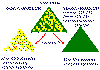
Hybrid Selection

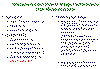



Criteria for Selecting Silage Hybrids
- Grain yield: allows flexibility (dual purpose)
- Whole plant silage yield
- Relative maturity: 5-10 days later than grain hybrids
- Standability: allows flexibility
- Pest resistance
- Silage quality
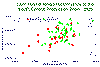
"Variation for silage yield and quality exists among commercial hybrids in
Wisconsin."
"Dual Purpose" Hybrids versus Silage Specific
Other silage Hybrids
- High sugar
- Waxy
- High-oil
- Leafy Corn
- Bmr Corn
- Tropical
- Sweet corn
Silage Quality
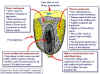
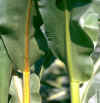
Bt
versus Conventional hybrids
Management Guidelines for Corn Silage

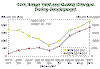
Silage yield and quality changes during corn growth and development
Planting date response
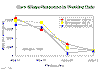
Plant density response
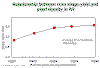
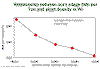
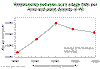
Row spacing response
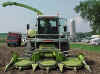
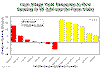
Cutting height response
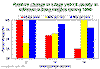
When to Harvest
Harvest timing depends upon storage structure

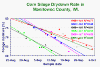
Environment drydown rate average = 0.5% per day
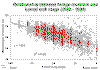
Kernel milkline: use as a guide


Predicting corn silage harvest date
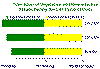

- Planting date
- Hybrid Relative Maturity
- Silking date: add 42 to 47 days
- Once kernel milkline begins to move measure whole-plant moisture and use drydown
rate = 0.5% per day
- Final check
Harvesting Stressed Corn
- Frosted corn
- Drought-stressed corn
Fermentation
Silage additives
Silage Preservation--The
Role of Additives (A3544)
Storage structures
Further Reading
From Harvest to
Feed: Understanding Silage Management Penn State University Circular (2003)